

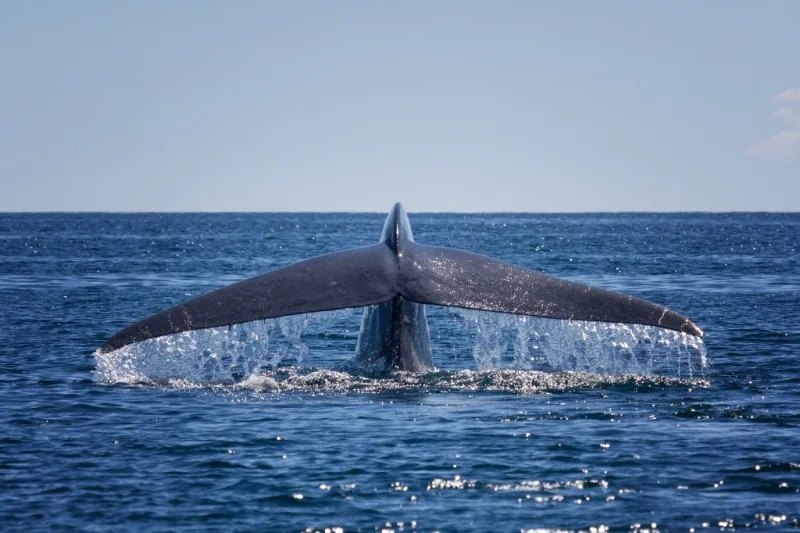
Today a spotter plane will take off early in the morning to find blue whales, before your helicopter
takes you to them, in perfect position to admire these remarkable mammals.
The blue whale, at up to 30 metres (98 ft) in length and with a maximum recorded weight of 173 tonnes is the largest animal known to have ever existed.
Blue whales were abundant in nearly all the oceans on Earth until the beginning of the twentieth century. For over a century, they were hunted almost to extinction by whalers until protected by the international community in 1966. The IUCN estimates that there are probably between 10,000 and 25,000 blue whales worldwide today. Before whaling, the largest population was in the Antarctic, numbering approximately 239,000 (range 202,000 to 311,000).
There remain only much smaller (around 2,000) concentrations in each of the eastern North Pacific, Antarctic, and Indian Ocean groups. There are two more groups in the North Atlantic, and at least two in the Southern Hemisphere. As of 2014, the Eastern North Pacific blue whale population had rebounded to nearly its pre-hunting population.
After your whales encounter, your helicopter will drop you off in the La Giganta mountain range, where your jeeps and atv’s await for a land base cultural expedition. The Mission of San Francisco Javier was founded in 1699 by Father
Francisco Maria Piccolo and the experience includes a visit to the cave paintings, the mission and the oldest olive tree in southern Baja. The charming village still employs gravity fed irrigation like the Jesuits did.